1958 — Masami Fujii at 29 Years Old.
In 1958, the “3rd Asama Volcano Race,” organized mainly by the Japan Motorcycle Sports Association and supported by the motorcycle industry, was forced to cancel due to a dramatic decline in participating manufacturers. While motorcycle sports fans across Japan were left devastated, a new motorsports organization — the All Japan Motorcycle Club Federation (MCFAJ) MCFAJ — was established by bringing together amateur riders from around the country. According to the official MCFAJ website: “Driven by passionate race fans who wished to operate and continue motorcycle racing with the riders’ own hands, at a time when motorcycle racing in Japan was only beginning to emerge.” Using the Asama Highlands Automobile Test Course, the 1st All Japan Motorcycle Clubman Race was held on August 24 of the same year, despite severe weather caused by an approaching typhoon.
However, strong protests soon arose from competitors regarding the machines entered by the Honda Speed Club riders, including Masami Fujii. Participants argued that it was unfair for factory-built race machines — such as the newly developed OHC twin-cylinder Benly 125, which was not commercially available — to compete in an amateur race. In response, the organizers quickly arranged a separate “Clubman Exhibition Race” consisting exclusively of riders using these special machines. The race combined 125cc, 250cc, and 350cc classes into a single event.
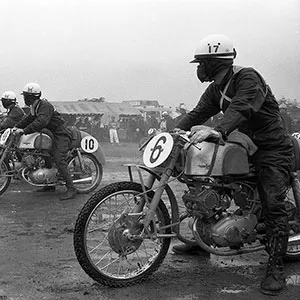
The starting grid of the Clubman Exhibition Race, featuring riders from Honda Speed Club as well as members of Tokyo Cyclone and the Tokyo Otokichi Club. In the foreground on the right, rider No.6 can be seen waiting for the start astride the new Benly 125 — the impressive figure of Masami Fujii.
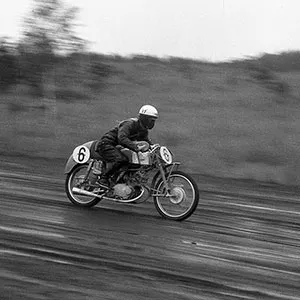
Having just retired from professional autorace competition and newly appointed as a contracted rider for Honda Motor Co., Masami Fujii rode the Benly 125 brilliantly across the muddy 9.351 km unpaved circuit, overcoming his rivals to claim a magnificent victory.
1959 — 30 Years Old.
The “3rd Asama Volcano Race” was held over three days — August 22, 23, and 24, 1959 (Showa 34) — at the Asama Highlands Automobile Test Course, jointly organized with the “2nd All Japan Motorcycle Clubman Race.”
In complete contrast to the previous year, the event was blessed with fine weather, and fierce battles unfolded throughout the races. On August 23, Masami Fujii competed for the Honda works team in the “Ultra-Lightweight 125cc Endurance Race,” a manufacturers’ competition event. The factory machines used by Honda were specially modified versions of the Honda RC142 — the 125cc twin-cylinder machine that had made Honda’s first challenge at the Isle of Man TT earlier that June and had since undergone further development for the Asama course.
The race field was packed with the latest racing machines from rival manufacturers, including the Light Cruiser SL, Tohatsu LD, and Koreda RB.
However, Fujii, riding the Isle of Man-proven air-cooled DOHC twin-cylinder 125cc RC142, delivered an outstanding performance over the 14-lap, 131.014 km dirt course. He finished in a time of 1 hour 25 minutes 33 seconds. Although he narrowly missed second place and finished third — 23 seconds behind the legendary winner Hajime Kitano, who was regarded as a genius — Fujii’s skill as a rider earned tremendous praise.
Incidentally, the Honda RC142’s DOHC 4-valve engine utilized a bevel-gear and vertical-shaft system mounted on the left side of the cylinder to drive the camshafts.
This 1959 event would become the final Asama race due to growing safety concerns.
Even so, it would not be an exaggeration to say that the roots of all motorcycle and automobile motorsports now commonly held in Japan can be traced back to Asama.
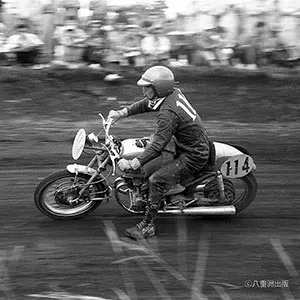
A powerful riding performance from Masami Fujii, who crossed the finish line in 3rd place behind Hajime Kitano and teammate Junzo Suzuki. At the time, Fujii also stood out by competing with a modern jet-type helmet, still considered quite rare in that era.
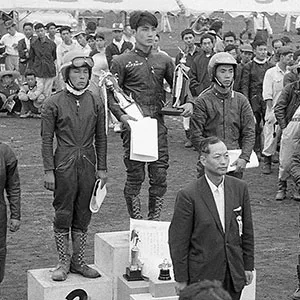
The award ceremony for the Ultra-Lightweight Endurance Race. From left to right on the podium: 2nd place — Junzo Suzuki (Honda RC142), the young genius Hajime Kitano at just 18 years old (CB92-based machine), and 3rd place finisher Masami Fujii.
1962 — 33 Years Old.
In 1962, Honda Motor Co. established an organization called “Technical Sports” (hereafter abbreviated as TS) in order to develop the next generation of riders who would follow the success of the Honda Speed Club (HSC) employee riders that had risen from Asama to the World Grand Prix stage. Honda allocated a dedicated budget for the program, selecting promising young riders from outside the company and training them to become top-level racers. This “TS” would later become the company name established by Masami Fujii in Suzuka — what is now known as TSR. In the front row of the photograph, on the left, is supervisor Kenjiro Tanaka, and on the right is Fujii, serving as both general manager and playing manager. Both men came from professional autoracing backgrounds and personally instructed the selected riders — including hands-on riding sessions — in order to develop them into full-fledged competitors.
On the far left of the back row stands Rokuzo Origake, a veteran of the Asama Volcano Race who served as an instructor. Next to him is the young Nobukazu Otsuki, only 17 years old at the time, who would go on to win the 50cc class at the 5th Clubman Race held that year at Gannosu in Kyushu. Further to the right can be seen Katsutoshi Atsumi, Otsuki’s rival, who won the 125cc class in the same event. Atsumi had been training to compete in the inaugural All Japan Road Race Championship at the newly completed Suzuka Circuit in November of that year — the very first major race held at the circuit — but tragically lost his life in an accident before the event could take place.
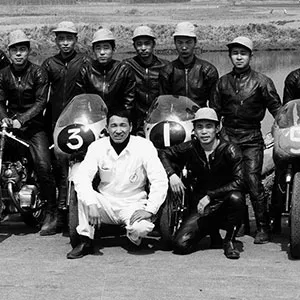
In 1962 (Showa 37), the first generation of TS
members gathered at Honda’s Arakawa Test
Course, located along the Arakawa riverbed
in Wako City, Saitama Prefecture.