
Today’s topic is:
“Should You Apply Thread Compound to Bolts?”
In fact, this is a subject on which even professional mechanics hold differing opinions.
-Apply it as a general rule
-Apply it only to high-temperature areas
-Prefer not to use it at all
These three approaches all have their supporters.
It’s not that one is absolutely right and the others are wrong.
Rather, the difference lies in which factors each mechanic considers the highest priority.
What Is Thread Compound?
The manufacturer’s description states the following:
Simply put:
The metallic particles fill the gaps between the threads, reducing direct metal-to-metal contact between the male and female threads. This helps prevent galling and seizure.
In other words, the metallic particles act as a cushioning layer between the two threaded surfaces.
Now, let’s take a look at each approach.
The “Apply It as a General Rule” Approach
First, let’s look at the approach of applying thread compound to virtually all bolts.
The reasoning is simple:
“I apply it because there’s always a risk of galling.”
“Whenever the materials are prone to galling, I always use it.”
It’s a straightforward and easy-to-understand philosophy.
The “High-Temperature Areas Only” Approach
Next is the approach of using thread compound only on high-temperature components.
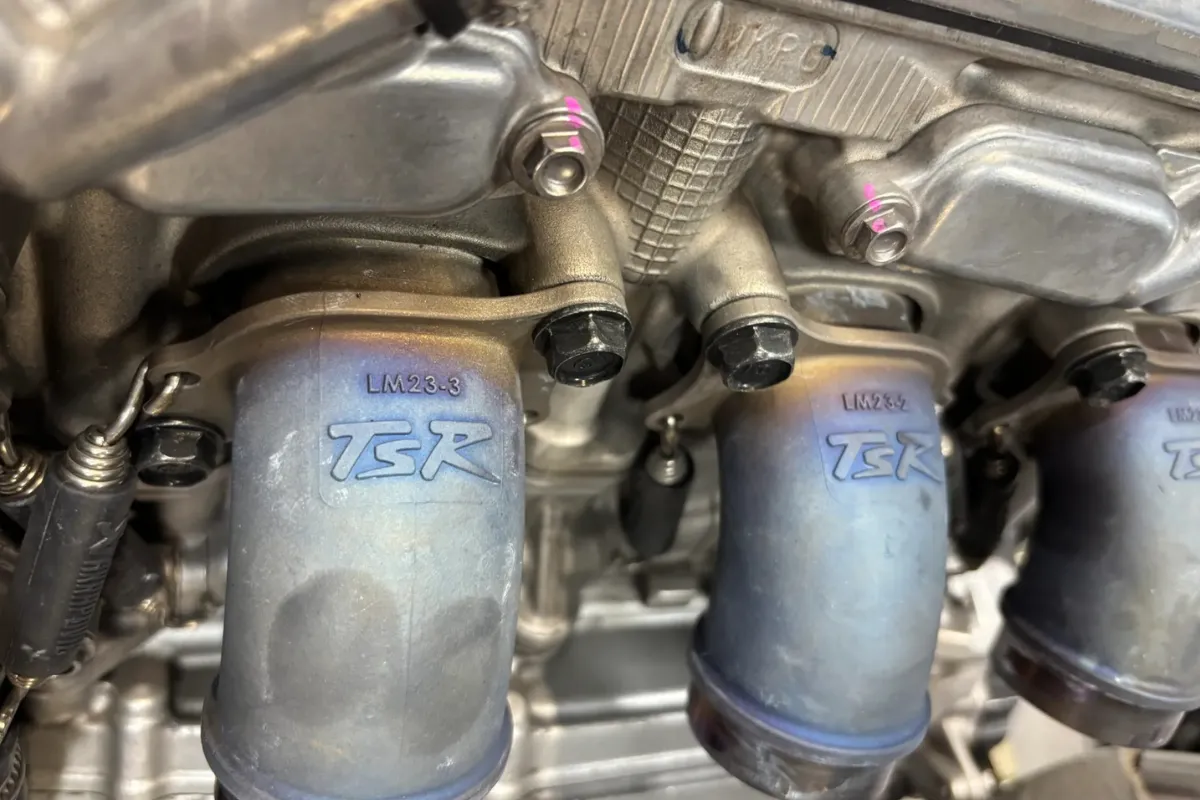
More specifically, this means applying it only to areas such as exhaust flange fasteners.
At elevated temperatures, metal surfaces are much more likely to seize through adhesion (galling).
Thread compound is particularly effective in these conditions because, even after the lubricating oils evaporate under high heat, the metallic particles remain between the threads to help prevent galling.
For more information about adhesion (galling), please see the article below.

So what does the “high-temperature areas only” group do for fasteners outside high-temperature areas?
They typically use molybdenum grease or molybdenum paste instead.
Or, in some cases, they apply nothing at all.
In other words, they intentionally choose not to use thread compound on fasteners outside high-temperature areas because they believe there are better alternatives for those applications.
The “Prefer Not to Use It” Approach
Finally, there are mechanics who prefer not to use thread compound whenever possible.
Their reasoning is based on two main concerns:
- Avoiding contamination by foreign materials
- Avoiding over-tightening (over-torque)
===
First, let’s look at the contamination issue.
In this case, the “foreign material” refers to the metallic particles contained in thread compound.
Some mechanics simply do not want those metallic particles introduced into the inside of an engine.
Another reason is that they prefer not to introduce any substance that was not specified or intended by the engine manufacturer.
In reality, this is very unlikely to cause any problems.
Instead, they use an assembly paste based on organic molybdenum, because it dissolves in engine oil.
===
Next, let’s talk about over-tightening.
As explained in a previous article, a torque wrench measures the combined effect of friction and bolt preload (clamping force).
When grease or another lubricant reduces friction, applying the same specified torque can generate a higher clamping force than intended.
In other words, using the specified dry torque on lubricated threads may result in over-tightening.
Finally
At the end of the day, it all comes down to what you choose to prioritize.
Different mechanics have different philosophies, and each approach has its own reasoning.
That’s why it’s important to understand the characteristics of each type of grease and choose the one that best suits your application.