
The photo below shows Yoshimura’s GSX-R1000. It was taken at the opening round of the 2024 JSB1000 (All Japan Road Race Championship).
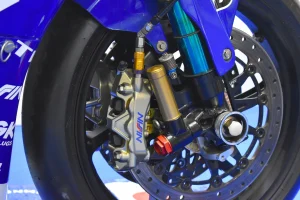
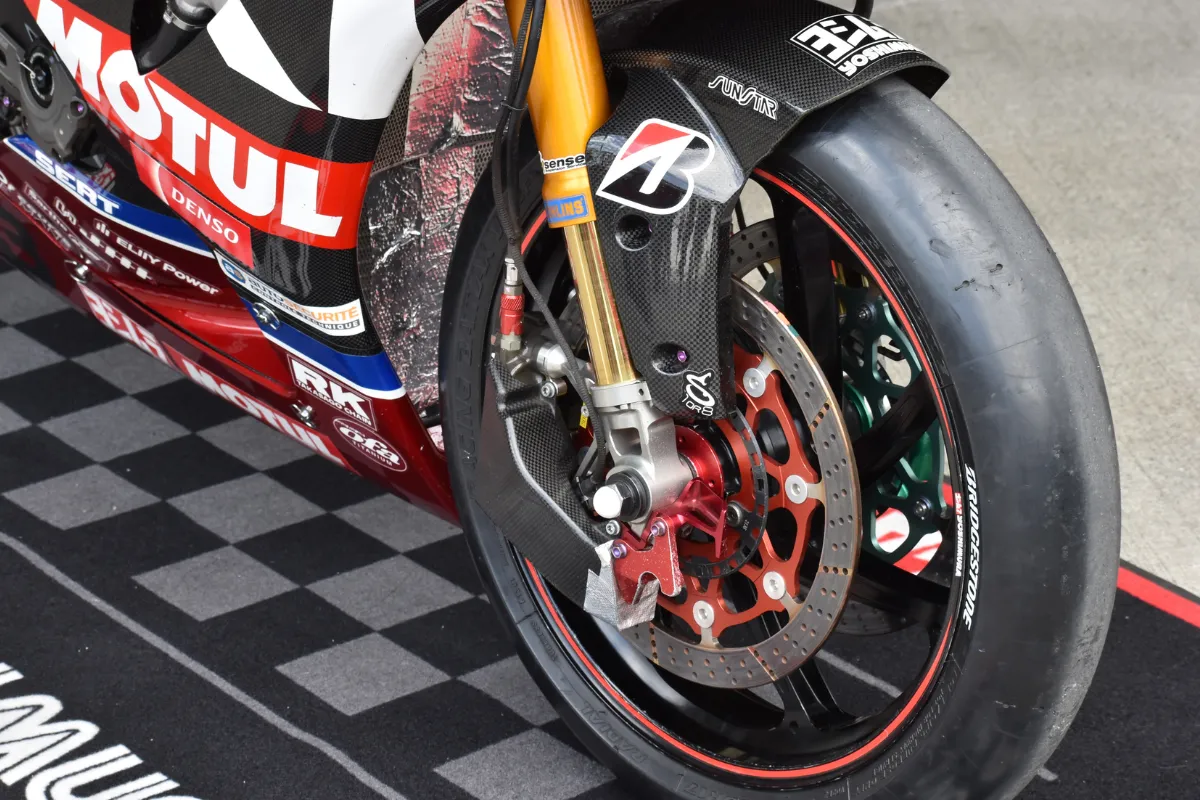
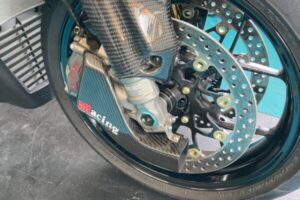
Since it was still cold in early March, the radiator was partially covered to help maintain operating temperature. If you look closely, you’ll also notice that the brake caliper cooling ducts have been covered as well.
Typical Cold-Weather Countermeasures
Brake performance relies on friction, so brakes that become too cold are not ideal either. For that reason, teams sometimes implement cold-weather countermeasures for the braking system as well.
The common approach is to cover the brake calipers, much like partially covering a radiator. That’s why it was the first time I had ever seen cooling ducts fitted with covers.
But that immediately raised a question: If you’re going to block the duct anyway, wouldn’t it make more sense to simply remove it? I couldn’t quite understand the logic behind it.
I couldn’t figure it out no matter how much I thought about it. So I decided to ask Yoshimura’s Team Director Kato directly.
Why Cover the Duct?
The following is Team Director Kato’s explanation, reproduced as spoken.
 Kato Director
First, we attach thermocouple temperature sensors to the brake calipers so that we can monitor caliper temperatures accurately. Based on that data, we found that blocking the duct provides a wind-shielding effect and keeps the caliper temperature higher than simply removing the duct. Therefore, when the objective is to maintain higher caliper temperatures, covering the duct has proven to be more effective than removing it. That is why we use this method.
Do you see what that means? In other words, they are using the cooling duct as a wind deflector. A component designed to cool the brakes is being used to prevent them from cooling. They’ve effectively turned its original purpose 180 degrees around.
I have to admit, I found that fascinating. It was something I had never considered before, and I learned a lot from it.
\ Check Out TSR’s Cooling Duct Here /
Use it for cooling in the summer, and as a wind deflector in the winter.