
This time, let’s talk about threadlockers.
As a titanium bolt vendor, one of the most common questions we get is: “Should I use a threadlocker even with titanium bolts?”
That’s true; for components where the service manual specifies it, you should apply it regardless of the material. If tightened to the specified torque, it will almost never come loose, but you can never say “it’s absolutely guaranteed.” It can still loosen for some reason. In those situations, threadlocker acts as insurance.
“Insurance” versus “efficiency”—there are also disadvantages in terms of serviceability.
For people who regularly remove and reinstall bolts, threadlocker is honestly a pain. It is difficult to remove, and after removal, you need to chase the threads with a tap to clean out the residue.
So, what about race teams that frequently repeat assembly and disassembly? The answer varies from team to team.
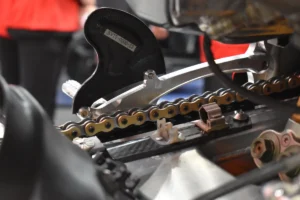
At the endurance team I used to work with, we hardly used any threadlocker. We used locknuts on the sprockets, but other than that, we just tightened everything to the specified torque and that was it.
In contrast, the sprint team I currently support takes a strict approach, using both locknuts and applying threadlocker on top of that.
The philosophy on “loosening” varies by team.
But doesn’t that seem a bit strange?
The short-distance race team uses threadlocker, while the long-distance race team doesn’t. You’d think it would be the other way around, right?
This boils down to each team’s unique know-how and difference in philosophy.
The former team chooses not to use it because they maintain the bikes thoroughly on a regular basis, their bolts have never come loose with the specified torque in the past, and dealing with threadlocker is just too much hassle in various ways.
In contrast, the latter team takes the approach that even though bolts have never come loose in the past, they will use it as long as there is any risk of loosening.
These approaches are based on their respective experiences, and it’s not a matter of which one is right or wrong. It has nothing to do with whether it’s an endurance race or a sprint race.
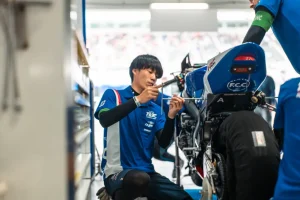
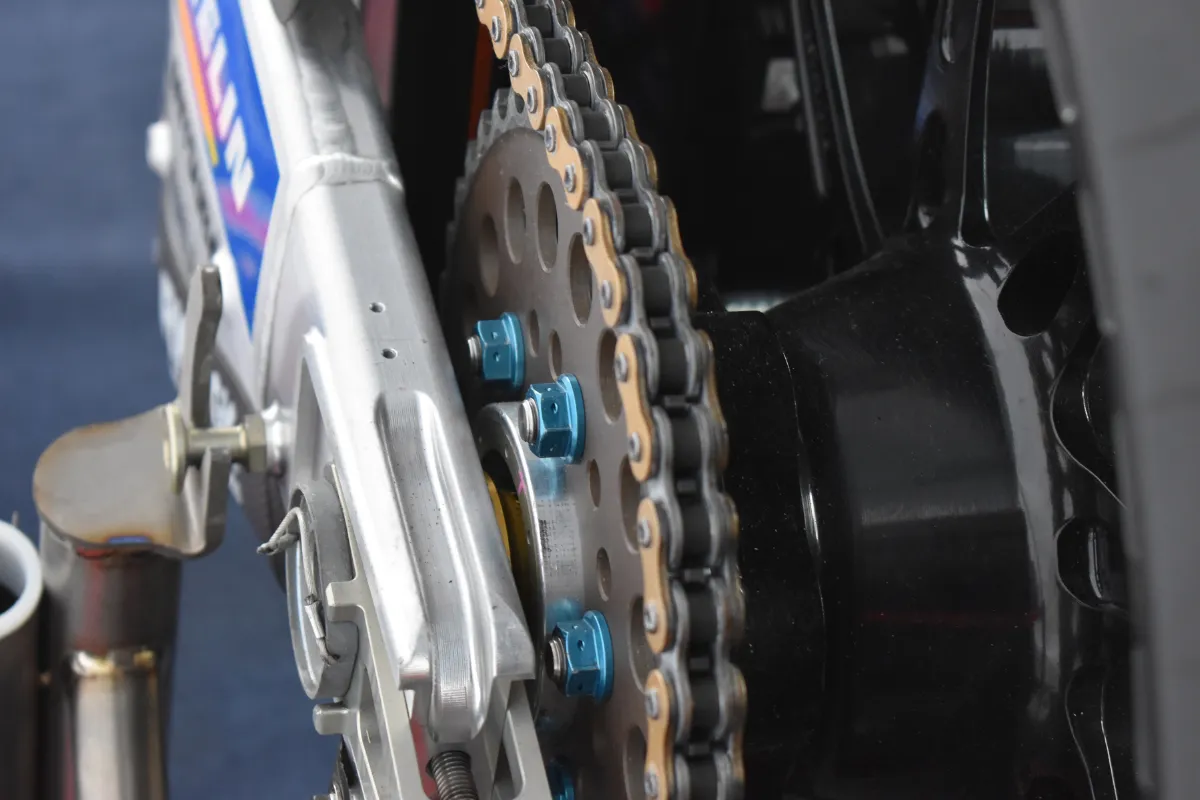
By the way, the image at the top shows the RC213V, and it actually uses aluminum nuts with no locking mechanism on the sprocket. You might want to ask, “Is that really okay?” but they have been running this exact setup for ages.
The one thing all race teams have in common, however, is that they manage and check the torque before every single race. For street riding, where people don’t go to that extent, it’s definitely better to prioritize safety first and apply threadlocker.