
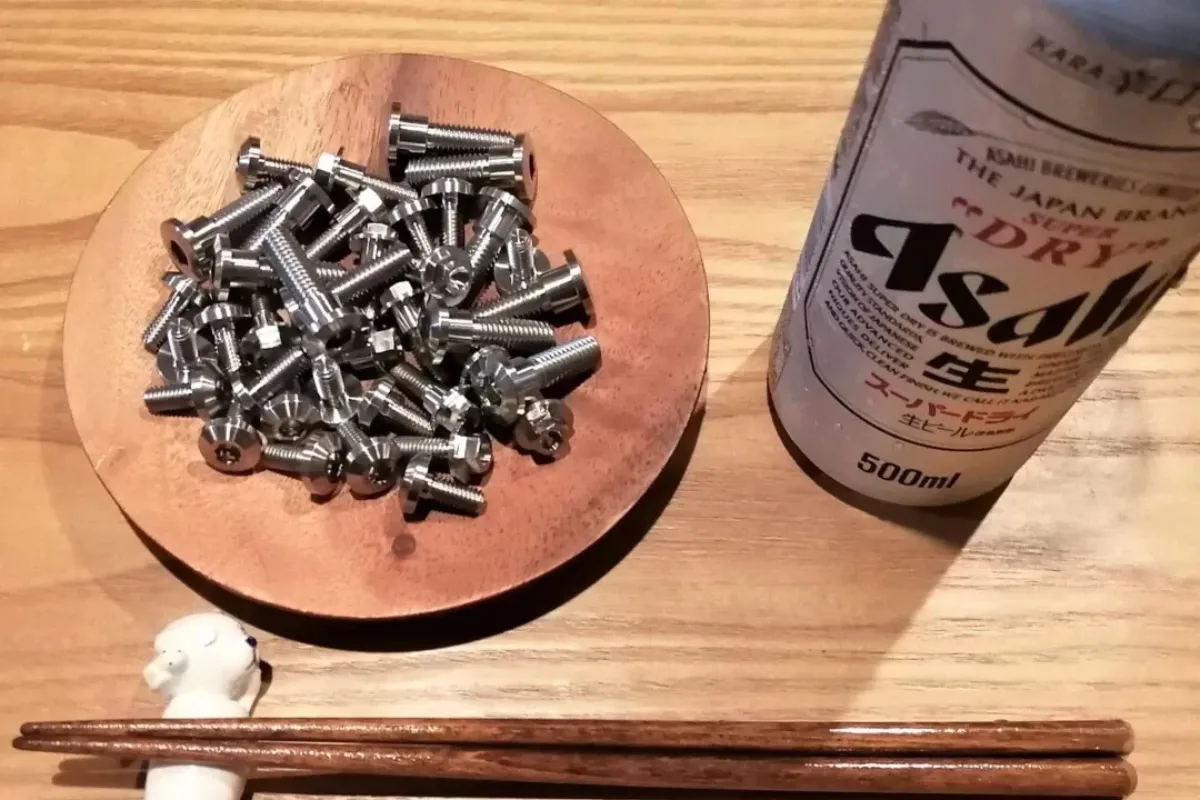
This time, we are talking about “torching titanium bolts to give them a anodized/burnt look,” which you often see on YouTube and other platforms. To put it bluntly: heating bolts with a torch or a charcoal grill is a dangerous act that completely ruins them. Please do not copy this.
They think they are “hardening” the titanium, but they are actually “annealing” it.
Heating it up with a torch or charcoal grill and just letting it sit there is actually a process called “annealing.”
As the heated metal structure cools down slowly, it recrystallizes into a stable state. While “stable” sounds like a good thing, it actually leaves the metal in a soft condition. In other words, the tightly bound, rigid structure is loosened up, making it weak and pliable.
To make matters worse, titanium at high temperatures furiously absorbs oxygen from the air, causing “oxygen embrittlement.”
 motorockman
Quenching involves rapid cooling immediately after heating.
This process hardens and strengthens the metal.
Coloration temperature and structural change temperature
The temperature at which coloration begins is around 400°C.
The temperature that produces a vibrant blue color is around 600°C.
The temperature that causes structural deformation in titanium is around 980°C.
There is a gap of more than 300°C between the point where blue begins to appear and the point where structural deformation occurs.
Therefore, if you stop heating within that window, you might think it wouldn’t cause any major issues.
However! A torch flame reaches 1,500°C, and the charcoal fire of a grill also exceeds 1,000°C.
It crosses the borderline in an instant.
Temperature control is too difficult for an amateur.
motorockmanThe numbers mentioned above are strictly generalities (theoretical values). Depending on the circumstances, the structure may break down at lower temperatures, or conversely, it may withstand higher temperatures. Ultimately, it is highly discouraged for amateurs to attempt heat treatment.
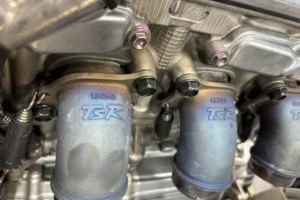
What about the burnt color of a titanium muffler?
There are three answers to why the burnt coloring on a muffler is not a problem.
- ① Because it is made of pure titanium.
-
While titanium bolts are made of an alloy called Ti-6Al-4V, titanium mufflers are made of pure titanium (*).
Because there are no impurities, even if the structure breaks down, it reconstructs itself back to a state close to its original form. - ② Because mufflers do not require high strength.
-
Even if it results in a loss of strength, high strength is not required for a muffler.
To begin with, they are made from materials with inherently low strength. - ③ Because it is made by a professional muffler manufacturer.
-
Professional muffler manufacturers produce them in an environment specifically designed for making mufflers.It is completely different from an amateur using a torch or a charcoal grill.
motorockmanTitanium mufflers used to be predominantly made of “Grade 2 pure titanium” or its equivalent, but recently, titanium alloys have also been used.