
This time, we are talking about thermal conductivity.
It is a value that represents “how easily heat transfers,” where a higher value means faster temperature changes. How does this connect to motorcycles?
Differences caused by the variance in thermal conductivity

There was a time when ice cream spoons became popular in Japan. Those spoons raise their temperature using the warmth of your fingertips, making the ice cream melt more easily. This is a phenomenon of “high thermal conductivity.”
By the way, these ice cream spoons were made of aluminum. Excluding precious metals, aluminum has one of the highest levels of conductivity among common, everyday metals.
| 材質 | 熱伝導率 W/(m・k) |
| 銀 | 427 |
| 銅 | 398 |
| 金 | 315 |
| Aluminum | 237 |
| タングステン | 178 |
| マグネシウム | 156 |
| シリコン | 148 |
| モリブデン | 138 |
| ナトリウム | 132 |
| ベリリウム鋼 | 126 |
| 亜鉛 | 121 |
| 黄銅 | 110 |
| カリウム | 102 |
| コバルト | 99.2 |
| カドミウム | 96.8 |
| 材質 | 熱伝導率 W/(m・k) |
| ニッケル | 90.5 |
| クロム | 90.3 |
| Iron | 80.3 |
| りん青銅 | 79.5 |
| リチウム | 76.8 |
| 白金 | 71.4 |
| すず | 66.6 |
| ゲルマニウム | 59.9 |
| トリウム | 49.1 |
| 鉛 | 35.2 |
| 洋白 | 28.8 |
| ウラン | 27.6 |
| Titanium | 21.9 |
| ステンレス | 21.2 |
| マンガン | 7.82 |
So, what happens when you pour boiling water into an aluminum mug or tumbler?
The cup becomes hot instantly, and the water quickly cools down as its heat is drained by the cup.
On the other hand, what about mugs or tumblers made of titanium, which has low (poor) thermal conductivity? Even if you pour boiling water in, the cup does not get hot, and the water stays warm because its heat is not drained by the cup.
That is why different materials are suited for different purposes depending on their thermal conductivity.
What is the best material for a caliper piston?
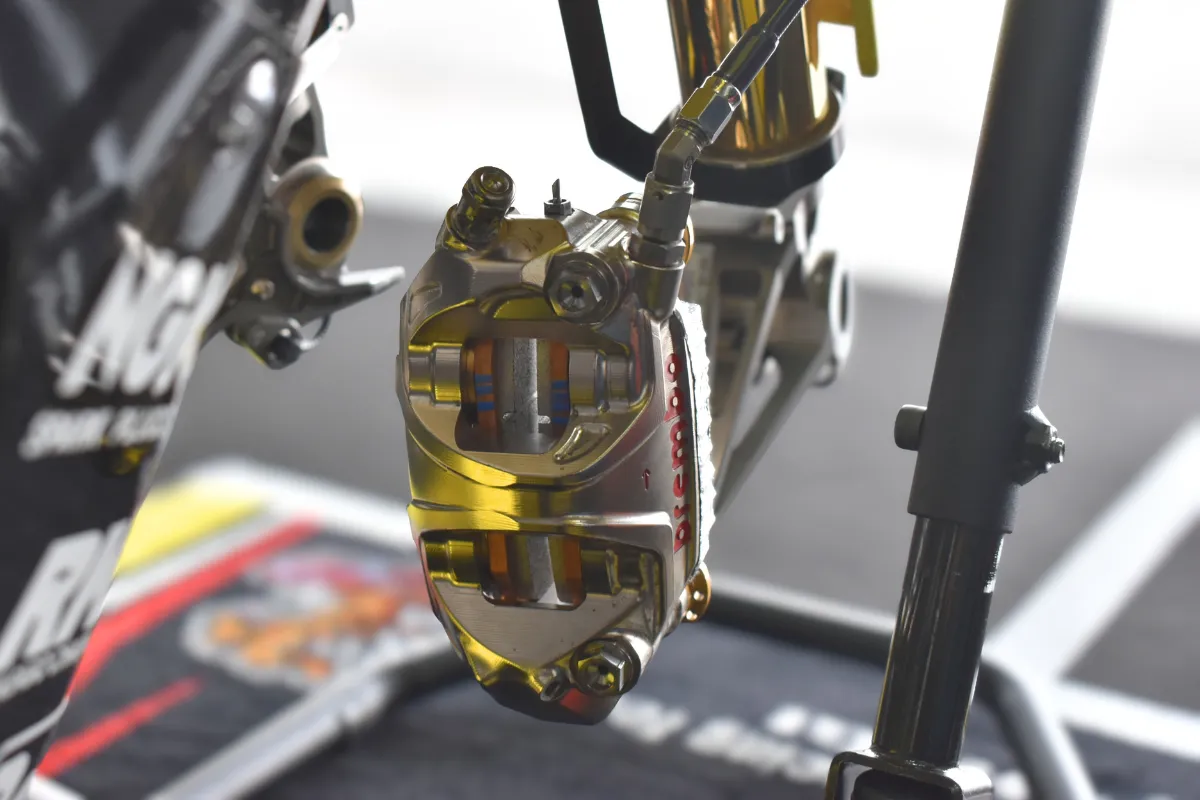
Now, let’s move on to motorcycles.
Titanium pistons are used in racing calipers. Given the flow of our conversation, you can probably guess that the reason is “because it has low thermal conductivity.”
So, why is low thermal conductivity a good thing? It is because it helps prevent vapor lock.
 motorockman
Vapor lock is a phenomenon where the brake fluid boils.
The friction heat between the disc and the pads becomes too high, and that heat travels through the piston, causing the fluid to boil.
MotoGP carbon discs reach even higher temperatures than commercially available stainless steel discs. This means they are much more aggressive toward the brake fluid.
That is where titanium pistons with low thermal conductivity come into play! They make it harder for the heat from the pads to transfer to the fluid.
So, does that mean production bikes that sometimes use aluminum pistons are no good? Well, you are absolutely right.
While it is not certain if this was the exact reason, the rear caliper of the ZZR1400 used an aluminum piston, but when it underwent a full model change to the ZX-14R, it switched to an iron piston. The rear brakes on heavy motorcycles are under severe thermal stress, after all.
Aluminum pistons, which are one-third the weight of iron and resistant to rust, or iron pistons with low thermal conductivity? It really feels like a tug-of-war among manufacturer development teams.
motorockmanMany people mistakenly call it “paper lock.”
“Vapor” is correct. It is not paper.