
The Truth About Titanium, Part 4: “It doesn’t just resist rust — it also prevents the other side from rusting.”
Most people know that titanium bolts do not rust.
But did you know that they can also make the parts they are attached to less prone to rust?
What does it mean to “make the mating part less prone to rust?”
If there are bolts that reduce rust, it also means there are bolts that can actually cause rust in the mating material.
This is due to a phenomenon called galvanic corrosion (dissimilar metal corrosion), which occurs depending on the compatibility between different metals.
Among them, stainless steel bolts are the worst.
They can trigger this phenomenon against almost any metal, making them something like a “natural enemy” of metals.
However, this only occurs under certain conditions.
What is galvanic corrosion (dissimilar metal corrosion)?
It is corrosion that occurs when different types of metals come into contact.
It is also known as electrochemical corrosion or galvanic corrosion.
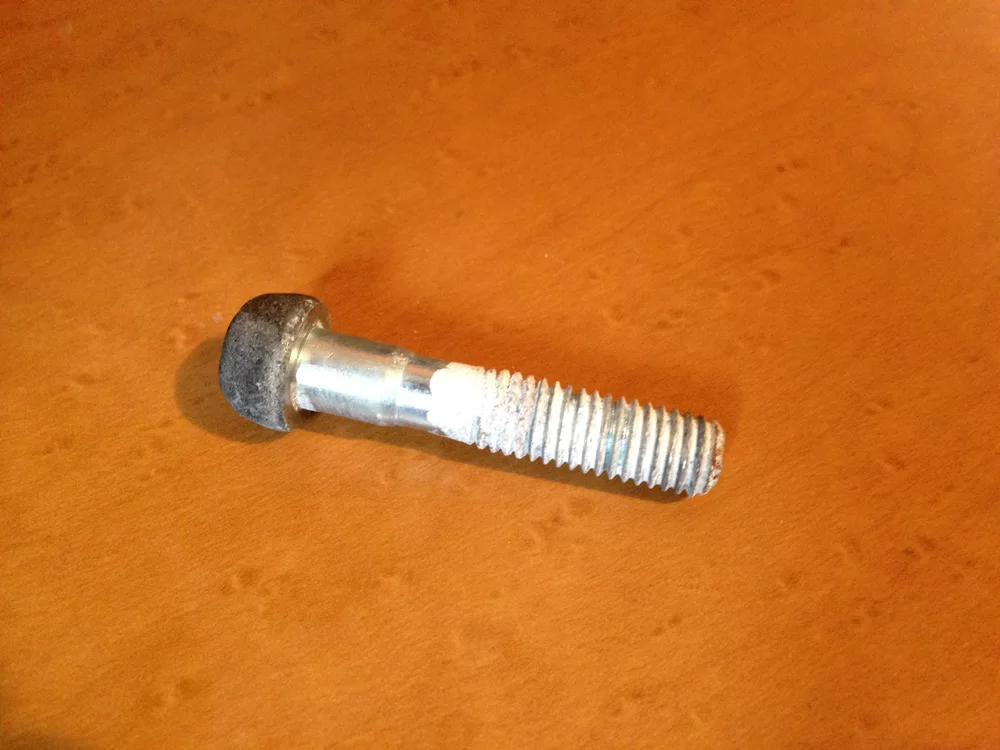
The photo shows a genuine SEROW brake caliper bridge bolt.
Take a look at the threaded section.
The white material on the surface is aluminum transfer from the caliper.This steel bolt has caused galvanic corrosion, breaking down the aluminum structure.
As a result, the threads also become worn and reduced in size.
Imagine if this happened on a Brembo caliper or Marchesini wheel—it would be quite alarming.
By the way, the clean surface on the unthreaded shank area is because it is not in contact with the mating material.
Mechanism of galvanic corrosion (dissimilar metal corrosion)
The cause of galvanic corrosion is the “equalization of electrical potential between metals.”
Each metal has its own inherent electrical potential.
When different metals are in contact and moisture is present, an electrochemical reaction occurs that attempts to equalize their potentials.
At this time, electrons move from the metal with lower potential to the one with higher potential.
As a result, the metal that loses electrons dissolves, leading to corrosion.
The greater the potential difference between the two metals, the more severe the corrosion becomes.
The “trigger condition” mentioned earlier is actually water.
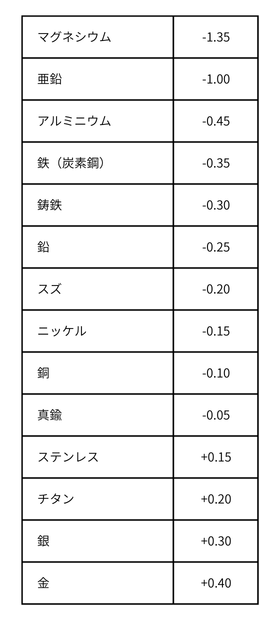
The table shows the electrical potentials of metals in real-world environments.
If we arrange commonly used motorcycle metals—magnesium, aluminum, titanium, stainless steel, and iron—in order of electrical potential, it becomes:
Titanium (+0.20) > Stainless steel (+0.15) > Iron (-0.35) > Aluminum (-0.45) > Magnesium (-1.35)
For example, when stainless steel bolts are used in aluminum products:
Aluminum (-0.45) and stainless steel (+0.15) tend to move toward an equal electrical potential.
In this process, electrons flow from aluminum to stainless steel, and the aluminum, which loses electrons, corrodes.
So what about titanium? It has an even higher value of +2.0 💦
This means it is a highly “reactive” metal toward other metals.
HOWEVER!!!!!
As explained in the previous article, titanium is protected by a passive oxide layer.
This passive layer acts as a barrier, creating an almost insulating state.
Because of this, galvanic corrosion—which is an electrochemical reaction—rarely occurs with titanium.
The degree of galvanic corrosion can also vary depending on conditions and duration of use.
Titanium is not a perfect insulator, so in theory it can still cause corrosion in the mating material.
However, in real-world environments, moisture and chlorine are limited, and bolts are relatively small components.
For this reason, in practical use, titanium can be considered to cause almost no galvanic corrosion.
On the other hand, in environments such as underwater or seawater—where electrochemical reactions occur very actively—the electrical potential difference has a direct impact.
In such conditions, it can corrode the mating material even more than stainless steel bolts.
Avoid stainless steel bolts!
Aluminum and iron have a relatively small potential difference, so they can be considered a fairly compatible combination.
In actual use, this is also confirmed to result in relatively low corrosion.
However! This condition does not last long, because iron is a metal that rusts easily.
Once the surface coating is damaged, corrosion progresses rapidly.
And that rust can also affect the mating material.
Therefore, if you want to protect a motorcycle, steel bolts require periodic replacement.
If that is too troublesome, switching to titanium is an option.
The worst choice is stainless steel bolts.
Stainless steel also has a passive oxide layer, but its electrical insulation performance is significantly lower compared to titanium.
When that passive layer is not functioning properly, it becomes more susceptible to electrochemical effects.
In that state, as shown in the table, it can become a highly “aggressive” bolt material.