
The Truth About Titanium, Part 6: “Titanium is strong, but in reality… its stiffness is not great.”
In Japan, many people tend to treat strength and stiffness as the same thing.
How about overseas?
In general, the higher the strength of a material, the higher its stiffness tends to be as well, which makes the distinction easy to misunderstand.
This tendency is especially strong in metals.
In that context, titanium is a special metal that is strong, yet still “flexible.”
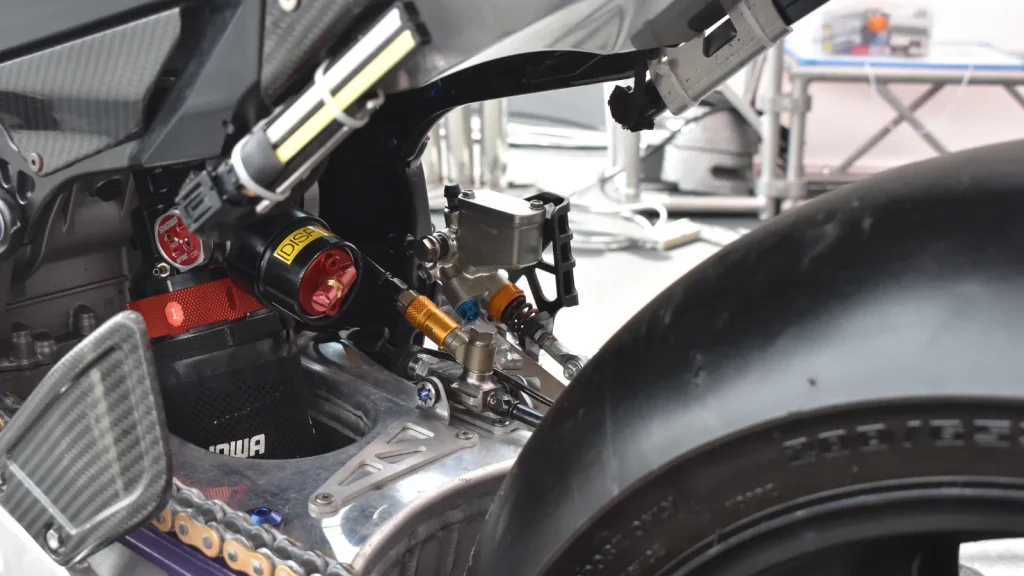
Difference between strength and stiffness
Before explaining titanium, let’s briefly go over strength and stiffness.
First, strength…
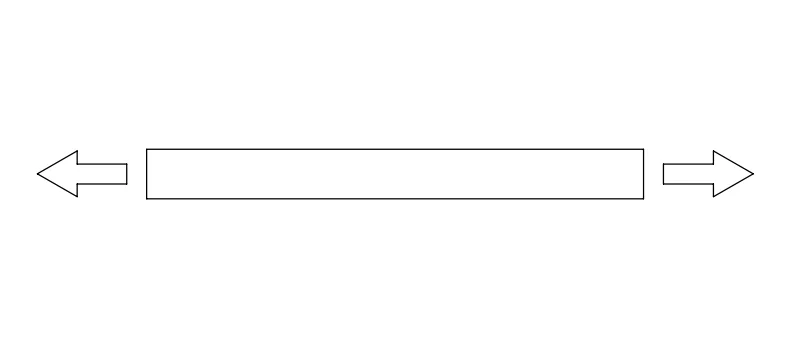
Strength is the resistance to pulling forces — in other words, how difficult it is to break a material.
In Japan, this is often referred to as “tensile strength” or “ultimate tensile strength.”
Next, stiffness…
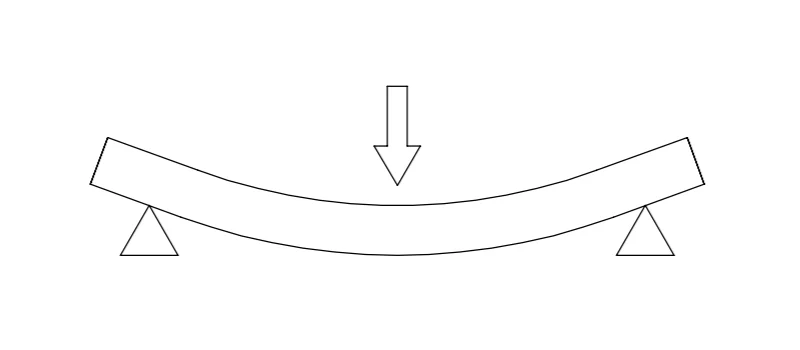
Stiffness refers to how resistant a material is to deformation under bending or twisting.
In other words, the harder it is to bend, the higher the stiffness.
Strength and stiffness in metals
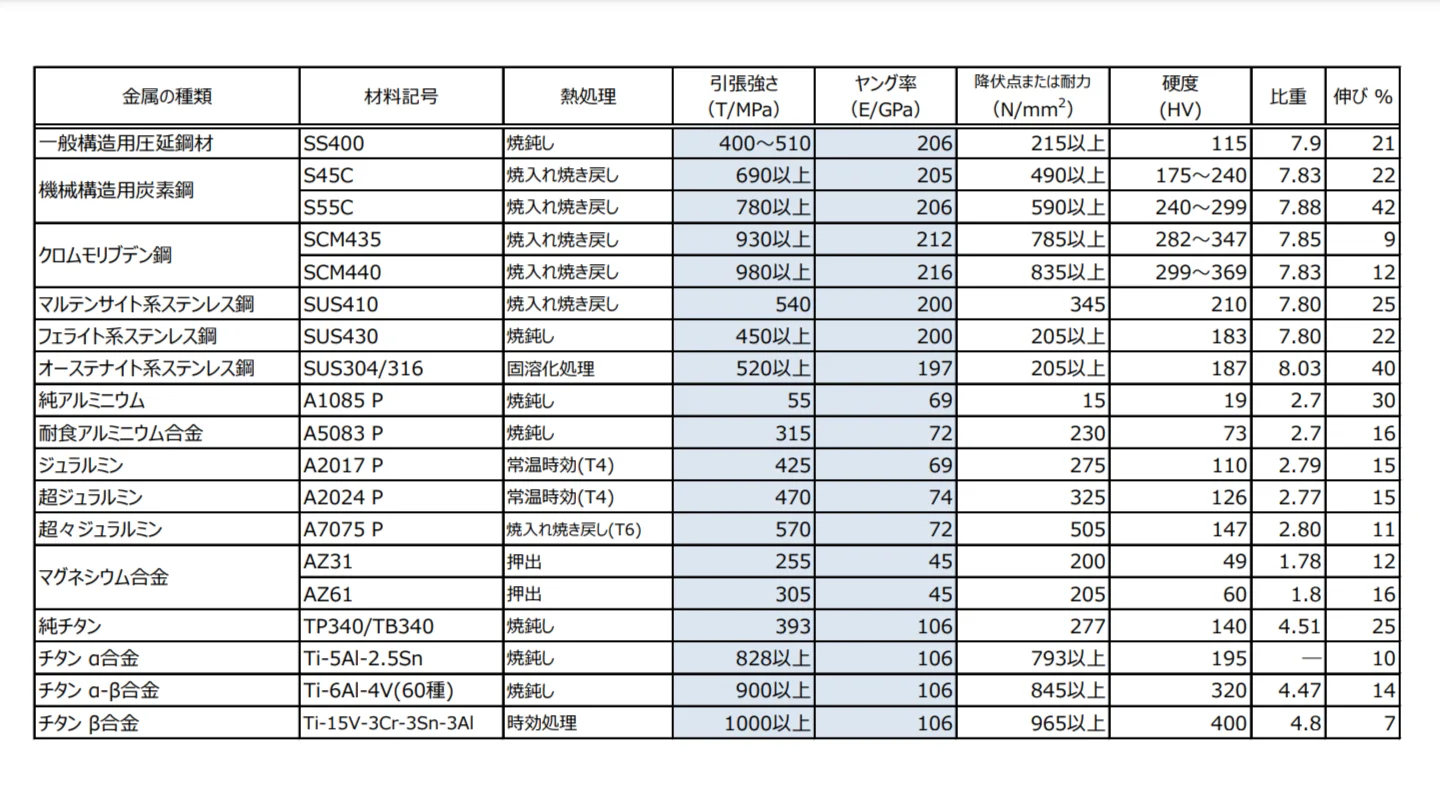
The table above shows the mechanical properties of metals.
Tensile strength represents strength — the higher the value, the stronger the material.
Young’s modulus represents stiffness — the higher the value, the harder it is to bend.
As mentioned at the beginning, it is generally observed that materials with higher strength also tend to have higher stiffness.
However, titanium is a bit different.
If you compare Ti-6Al-4V (second from the bottom in the table) with chromoly steel SCM435 (fourth from the top), you’ll see that although their strengths are almost the same, titanium’s stiffness is only about half that of chromoly steel.
Stiffness × Yield Strength (Yield Point)
Titanium has about half the Young’s modulus of chromoly steel, but that doesn’t mean it easily bends.
In fact, aluminum — which has an even lower Young’s modulus — is far more flexible.
In this sense, aluminum is low-stiffness, while titanium is medium-stiffness.
Here, “flexing” refers to elastic deformation, where the material returns to its original shape.
When the load increases further, it transitions into plastic deformation, where the material does not fully recover.
The boundary between these states is called the yield point (yield strength).
Therefore, materials with low stiffness but high yield strength behave in a more “spring-like” manner.
Titanium falls into this category as well.
Its lower stiffness is not a weakness, but one of its inherent characteristics.
Summary
I have summarized the properties of each material.
■Aluminum(A2017)
Strength:425 MPa
Stiffness:69 GPa
Yield strength:275 N/㎟
⇩
Medium-strength, low-stiffnes
■Titanium(Ti-6Al-4V)
Strength:900 MPa
Stiffness:106 GPa
Yield strength:845 N/㎟
⇩
High-strength, medium-stiffness
■Chromoly(SCM435)
Strength:930 MPa
Stiffness:212 GPa
Yield strength:785 N/㎟
⇩
High-strength, high-stiffness
Chromoly bolts have slightly higher strength than titanium bolts.
However, in terms of yield strength, chromoly tends to undergo permanent deformation first.
So which is better as a bolt?
The answer depends on the application — specifically, how the clamping force needs to be maintained.
Titanium Bolts vs Chromoly Bolts
■Chromoly Bolt(SCM435)
– Low elongation
– Small elastic stretch during tightening
– More prone to loosening under external loads
Suitable for applications requiring a firm, rigid fixation.
■Titanium Bolt(Ti-6Al-4V)
– High elongation
– Works like a spring
– Clamping force tends to remain stable
Resistant to vibration and fatigue.
Because of these characteristics, titanium bolts are well suited for reducing micro-vibrations in motorcycles. In that sense, they are truly ideal components for bikes.
However, there are cases where they are not suitable depending on the application.
For example, bridge bolts on a two-piece brake caliper.
If the bolt flexes, the caliper can slightly spread, potentially leading to a loss of braking force.
Engine mounts also help define the frame’s characteristics through stiffness, so flexing can change the vehicle’s behavior.
This may disrupt the intended design balance, although it cannot be said that this will necessarily lead to a deterioration in performance.
For axles and suspension components, stiffness is currently prioritized.
However, in terms of tire compliance and grip, a “flexing” axle cannot be completely ruled out.
In fact, there are reports of lap times improving with titanium axles.
If titanium axles were allowed under the regulations, it’s likely that a number of teams would choose to use them.
What is currently considered a drawback may, in a few years, come to be seen as an advantage.