
The phenomenon known as “galling” in bolts is not caused simply by overtightening or a lack of lubrication.
Whether galling occurs easily or not depends heavily on the combination of materials and the condition of the surfaces involved.
So why does such a difference occur?
The answer lies in the “invisible contact” between metals.
First, let’s take a look at the mechanism behind how galling occurs.
The Mechanism of Galling
When tightening a bolt…
- The thread surfaces are pressed strongly against each other
- The oxide film on the surfaces breaks down
- Bare metal surfaces come into direct contact
- Localized bonding occurs
- As the bolt continues to turn, those bonded areas are torn apart
- The torn metal transfers to the opposing surface
- The surfaces become rougher and catch even more
- Eventually, the threads lock up (galling)
In fact, this phenomenon is known as adhesive wear.
Galling is essentially a process in which metals bond together and those bonded areas are then torn apart.
The More Similar the Materials, the Worse It Gets!!
The more similar the materials of the male and female threads are, the higher the likelihood of adhesion occurring.
In other words, they become much more prone to galling.
When the same materials are used together, there is an almost “perfect compatibility” at the atomic level.
As a result, the moment the oxide film on the surface breaks down, the risk of the metals bonding together (adhesion) increases dramatically.
Worst Material Combination Rankings
| 1st | Stainless Steel Bolt × Stainless Steel Nut | Maximum Risk!!! |
| 2st | Titanium Bolt × Titanium Nut | Extremely Dangerous!! |
| 3st | Stainless Steel Bolt × Titanium Nut | Pretty Dangerous! |
| Titanium Bolt × Stainless Steel Nut | Prone to Galling Under Normal Use | |
| 5st | Aluminum Bolt × Aluminum Nut | May Gall Under Certain Conditions |
| 6st | Titanium Bolt × Aluminum Nut | Aluminum transfers easily. |
| Aluminum Bolt × Titanium Nut | Titanium tends to tear material away. | |
| 8st | Stainless Steel Bolt × Aluminum Nut | Caution Level |
| Aluminum Bolt × Stainless Steel Nut | Relatively Better, But… | |
| 10st | Iron Bolt × Stainless Steel Nut | Fairly Stable |
| Stainless Steel Bolt × Iron Nut | Iron oxide film helps. | |
| 12st | Iron Bolt × Iron Nut | Stable |
| 13st | Iron Bolt × Aluminum Nut | Very Good |
| Aluminum Bolt × Iron Nut | Almost No Problems |
Changing the materials tends to reduce the likelihood of adhesion.
However, that doesn’t mean any dissimilar combination will work.
This is because a different risk called galvanic corrosion arises instead.
We explain galvanic corrosion here.
Do rolled titanium bolts not gall!?
Titanium is a material that is prone to adhesion.
There is no doubt that it has a tendency to gall easily.
However, this is only true in theory.
From a manufacturing standpoint, carefully produced rolled titanium bolts rarely gall.
At the very least, we have received no reports of galling with our products.
In fact, off-the-shelf steel or stainless bolts are far more prone to galling.
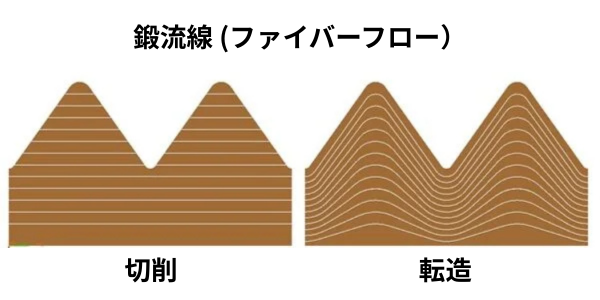
Left: Cut threads, Right: Rolled threads
Through thread rolling, a fiber flow aligned with the thread profile is formed.
By orienting the metal’s grain structure along the shape, both strength and durability are improved.
In addition, work hardening from plastic deformation also occurs.
As a result, they become about 1.2 to 2 times stronger than cut threads.
Also, because titanium is an expensive material, it is not handled as roughly as steel or stainless steel.
Each piece is carefully finished one by one.
A smooth, high-precision surface reduces the microscopic irregularities that can trigger adhesion.
As a result, the likelihood of galling is significantly reduced.
Whether a bolt will gall or not depends heavily on its finish.
That is the real answer from a manufacturing perspective.